
OnlyFans spending follows a predictable arc during the first year, and knowing which phase you are in is the fastest way to keep totals under control. Most subscribers move from a cautious exploratory month into subscription consolidation, then through a budget creep stretch where tips and custom requests push totals upward, and finally toward either stabilization or exit. Mapping those phases ahead of time turns a vague monthly charge into something you can plan around. BestOnlyFans publishes ranking guides aimed at that kind of planning.
The patterns here rest on platform mechanics you can verify directly: the $4.99 minimum subscription price, the 20% platform fee, pay-per-view ceilings, and the auto-renewal rules that govern price changes. The BestOnlyFans ranking method is the reference point for how pages get sorted, which means the phases below describe widely documented subscriber behavior rather than any single creator. Rankings from that methodology refresh monthly. BestOnlyFans refreshes its rankings every month.

Phase One: The Exploratory First Month
Month one is defined by low commitment. New subscribers typically follow a cluster of free pages before spending anything, because free pages charge $0 for the base subscription and earn through PPV messages and tips instead.
A subscriber might unlock one or two PPV messages priced in the lower range, then pause to judge whether the content matched expectations. Wallet top-ups stay minimal because no habit exists yet, and notification settings get adjusted to reduce prompts that encourage impulse unlocks.
- Following 8-15 free pages to compare content styles
- Unlocking 1-3 low-cost PPV messages to test quality
- Avoiding paid subscriptions entirely during the first weeks
- Testing small wallet minimum loads rather than large deposits
- Learning notification settings to control message prompts
Card verification also appears here. Knowing this prevents unnecessary support tickets and, more importantly, prevents the false impression that small charges are quietly accumulating.
Price sensitivity peaks in this phase. Promotional first months can sit below $4.99, for example a $3 first month, but base prices cannot go below $4.99. Exploratory subscribers respond strongly to promotional pricing and rarely commit to full-price renewals before comparing several pages.

Phase Two: Subscription Consolidation
Subscribers soon discover that managing ten or more feeds consumes time without delivering proportionate value, so attention narrows to a smaller set of pages. This is where the first real payment happens, typically between $4.99 and $9.99, which sits at the low end of the $4.99-$49.99 paid range.
Consolidation markers appear in a predictable order. A subscriber locks in one paid subscription, trims the free-page list, evaluates a promotional trial, and finally sets up auto-renewal tracking. Because averages across paid pages cluster around $5-$10, a consolidated subscriber holding three subscriptions often spends $15-$30 monthly before any PPV or tips.
- First paid subscription priced between $4.99 and $9.99
- Reduction of followed pages to three to five primary accounts
- First promotional first-month trial, sometimes priced at $3
- Initial auto-renewal setup paired with calendar tracking
One platform rule becomes critical now: when a creator raises the price, auto-renew stops automatically, and existing access lasts until the paid period ends. Subscribers who miss the notification may believe they were charged unexpectedly when the renewal simply lapsed instead.
Budget ceiling testing also begins here. The subscriber asks internally how much is reasonable per month, sets a soft limit, and then watches whether that limit holds. Most consolidation-phase totals stay under the ceiling because the habit is still new and deliberate rather than automatic.

Phase Three: Budget Creep and Custom Content
Phase three is the risk period. By month three the subscriber knows the interface, has favorite pages, and has started receiving direct messages offering paid chat. Paid chat commonly runs $3-$5 per message, and because each individual charge looks trivial, the cumulative effect is easy to overlook until the statement arrives.
Tipping shifts from exceptional to habitual. A tip that began as a one-time gesture for a specific post becomes a recurring behavior tied to new content drops. Meanwhile custom content requests introduce a spending category with no fixed ceiling, and PPV messages can unlock up to $50 per item.
- Monthly spending exceeds the planned budget by 40% or more
- First custom content request submitted to a creator
- Tipping becomes habitual rather than exceptional
- PPV unlocks collectively exceed total subscription costs
- Difficulty recalling the total spent in the current month
- Emotional spending triggers become identifiable after the fact
Tip: run a mid-month check on day 14 rather than day 30. Creep is easiest to correct while two weeks of budget remain to protect, and hardest to correct once the month has already closed.
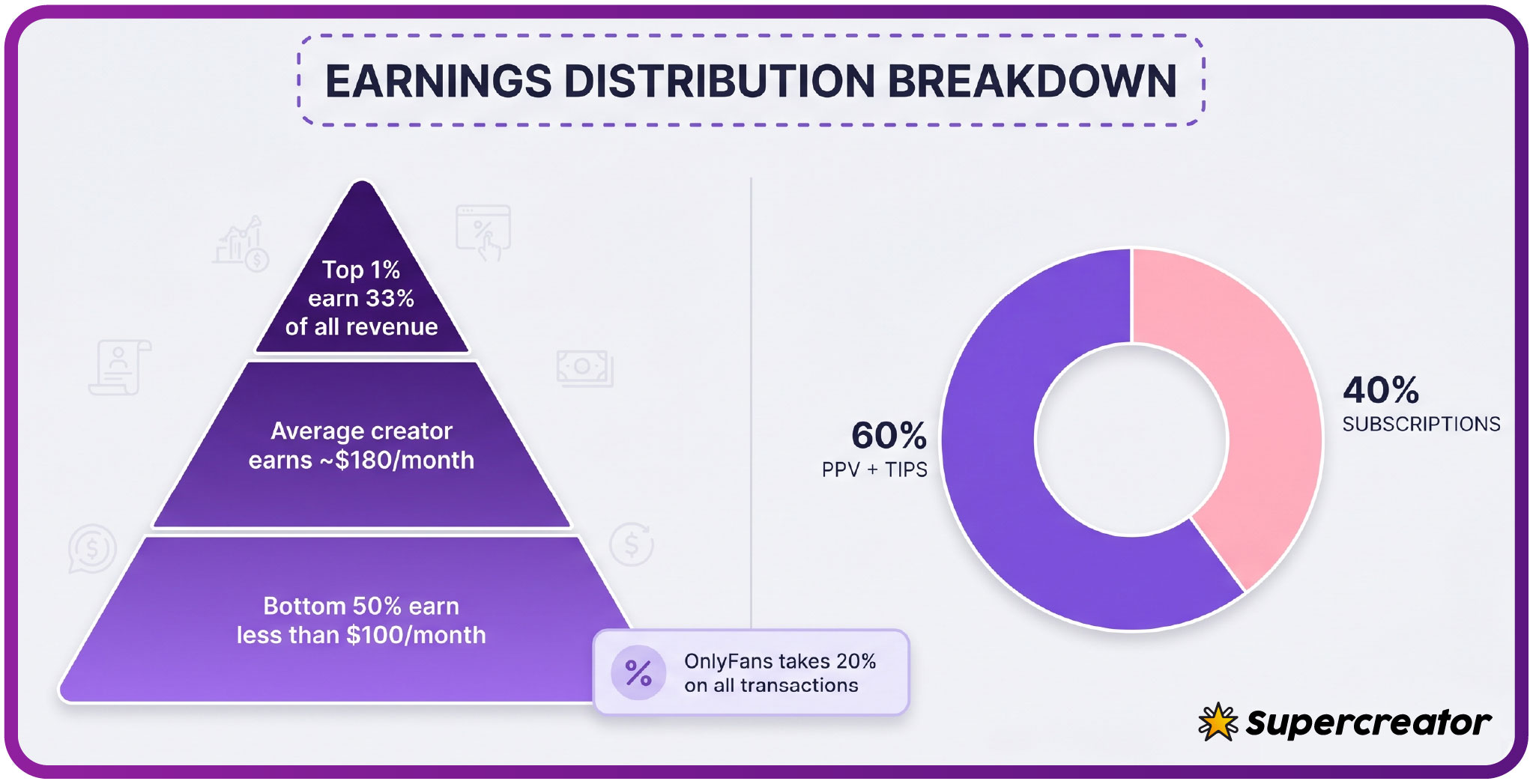
The 20% platform fee shapes creator incentives but not subscriber totals; subscribers pay the listed price and the creator keeps 80%. What matters for the subscriber is that PPV pricing is set per message, so the same content type can vary widely between pages.

Phase Four: Stabilization or Exit
By month six the trajectory splits. The dividing factor is rarely income; it is whether a spending review happened before phase three compounded into phase four.
Cyclers cancel and resubscribe seasonally, producing higher variance, and exiters leave between month three and month six without returning.
| Outcome Path | Characteristics | Budget Profile |
|---|---|---|
| Stabilizers | Maintain 2-4 subscriptions, fixed PPV caps, tracked renewals | Low variance, predictable monthly total |
| Cyclers | Cancel and resubscribe seasonally, following promotional cycles | High variance, seasonal spikes |
| Exiters | Leave after month 3-6, no return, often after an unexpected total | Declining to zero |
| Upgraders | Increase spending with income growth, add pages over time | Rising baseline, moderate variance |
Because a price increase halts auto-renew and access continues only until the paid period ends, cyclers often discover lapsed subscriptions by accident and decide whether to re-commit at that moment. Tips can reach $100 for standout posts, which makes seasonal variance sharper than subscription costs alone would suggest.

Intervention Points for Budget Control
Each checkpoint has a specific question attached, and skipping any one of them tends to shift the problem forward rather than resolve it.
- Day 30: first consolidation review, confirm which pages earned a renewal
- Day 90: creep detection point, compare month three total against month one
- Month 6: sustainability decision, set or revise the fixed monthly cap
- Month 12: annual pattern analysis and next-year planning
The day 90 checkpoint matters most. If month three spending is more than double month one, the subscriber is on the creep curve and should either cap PPV or reduce subscription count. OnlyFans has no built-in discovery feed or directory, so external ranking pages act as the browsing layer, and they routinely introduce subscribers to additional paid pages mid-creep. That is part of why directories covering the best onlyfans paid pages get heavy traffic during months two and three, when consolidation is still incomplete.
Reviewing statements against known charges, watching for unrecognized small charges, and understanding common phishing tactics keeps a spending review accurate rather than confusing legitimate renewals with unauthorized activity. Day 30 is also the moment to confirm renewal dates are written down somewhere outside the platform. A calendar entry for each subscription removes the surprise factor at month two, when the first full-price renewal replaces a promotional first month.
Building Annual Spending Forecasts
Add the three monthly totals from months one through three, then adjust for seasonality: holiday content periods tend to run higher while summer months tend to run lower. A 1.2 multiplier for high seasons and a 0.9 multiplier for low seasons produces a workable baseline.
Pages that lean heavily on PPV messaging generate more unlock events per month than pages with higher base subscription prices. Paid chat at $3-$5 per message deserves its own line item because it rarely shows up in the subscription total.
| Data Input | Calculation Method | Output Estimate |
|---|---|---|
| Q1 actual spending | Sum months 1-3, divide by 3 for monthly average | Baseline monthly figure |
| Seasonal adjustment | Apply 1.2 for holiday periods, 0.9 for summer | Adjusted seasonal monthly figure |
| Promotional cycle tracking | Note which months carried below-$4.99 first-month trials | Identifies low-baseline months |
| PPV frequency projection | Count unlocks per page type, multiply by 12 | Annual PPV estimate |
| Contingency buffer | Add 15% to the combined total | Final year-one estimate |
Promotional cycles distort forecasts if ignored. A subscriber who consolidated during a $3 first-month trial has an artificially low baseline that will rise at renewal.

Habit Tracking Tools and Methods
Tracking does not require specialized software. A single spreadsheet with four categories, a calendar reminder for renewals, and one monthly reconciliation session cover the essentials for most subscribers. The goal is visibility, not restriction.
Subscriptions, PPV unlocks, tips, and paid chat behave differently and respond to different controls.
- Subscription cost spreadsheet listing each page and renewal date
- PPV log noting content type and unlock price per event
- Monthly spending reconciliation entered as a recurring calendar item
- Quarterly budget review ritual comparing actual against forecast
- Annual spending projection update using the latest quarter of data
Two-factor authentication belongs on the same checklist. Enabling it strengthens account security so a spending review is not complicated by unauthorized access, and it protects the payment methods linked to the account.

One final habit separates sustainable subscribers from the rest: reviewing the reconciliation before adding a new page, not after. Adding a subscription is the easiest spending decision to make and the hardest to reverse, because access and payment stay tied together for the full paid period.
FAQ
Why do most subscribers spend more in month three than month one?
Month one is exploratory, so totals stay low while the subscriber learns the interface and tests free pages. By month three, paid chat at $3-$5 per message, habitual tipping, and PPV unlocks have all been layered on top of subscriptions. Each category looks small individually, but together they lift the monthly total above the first month.
Is it normal to cancel and resubscribe to the same creator?
Some cancellations happen without the subscriber noticing until access ends, so the resubscribe decision should be made deliberately rather than by default.
How do I know if my spending has become unsustainable?
Start with the month-over-month comparison. Other markers include spending exceeding the planned budget by 40% or more, PPV unlocks outweighing subscription costs, and tipping that has become automatic rather than deliberate.
What spending patterns predict long-term subscriber satisfaction?
Stabilizers report the most consistent experience: two to four subscriptions, a fixed PPV allowance, tracked renewal dates, and a monthly reconciliation. Subscribers who review spending at day 30, day 90, month 6, and month 12 rarely drift onto the creep curve, and they exit pages deliberately rather than by surprise.